





National Cooperation Policy 2025
Jun 12, 2026
Current Affair 1:
National Cooperation Policy 2025
News:

You can use this for introduction in Mains:
The National Cooperation Policy (NCP) 2025 marks a strategic roadmap for revitalizing India’s cooperative sector to meet the nation’s goal of becoming “Viksit” by 2047.
Rooted in the ethos of Sahkar-se-Samriddhi, this policy aims to build on the unique strengths of India’s cooperative tradition, promote economic democratization, and uplift rural economies through collective participation.
What is a Cooperative?
A cooperative is an autonomous association of persons, united voluntarily to meet their common economic, social, and cultural needs and aspirations through a jointly owned and democratically member-controlled enterprise.
|
The last cooperative policy, framed in 2002, was now proving to be outdated due to the radical shifts brought on by globalization, digitization, and socio-economic transformation.
Recognizing these developments, the Ministry of Cooperation (established in 2021) initiated the formulation of a new policy in September 2022.
A 48-member committee, led by Shri Suresh Prabhu, consulted stakeholders across 4 regional workshops and 17 meetings, collecting a total of 648 inputs to draft the current 2025 policy. |
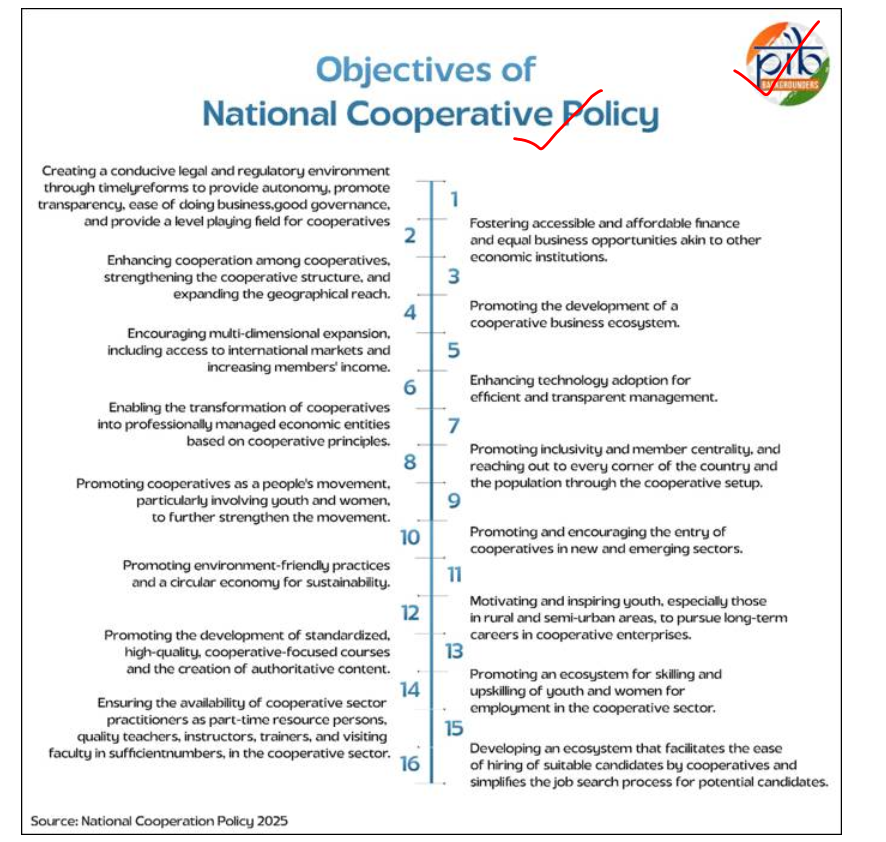
The policy is structured around six mission pillars and 16 objectives:

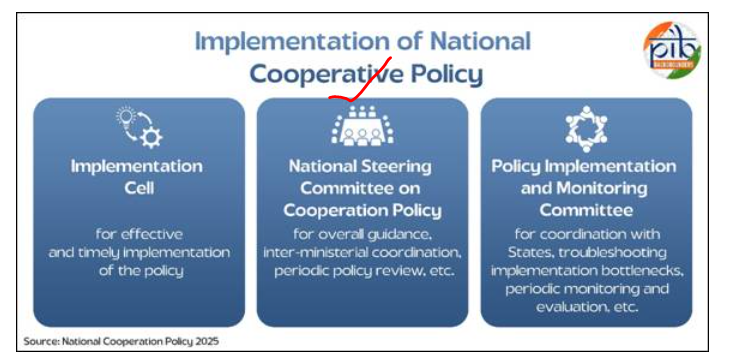
A robust multi-tier implementation structure is proposed:
- Implementation Cell within the Ministry of Cooperation with technical Project Management Unit support for effective and timely implementation of the policy.
- National Steering Committee on Cooperation Policy chaired by the Union Cooperation Minister will be constituted for overall guidance, inter-ministerial coordination, periodic policy review, etc.
- Policy Implementation and Monitoring Committee headed by the Union Cooperation Secretary for coordination with States, troubleshooting implementation bottlenecks, periodic monitoring and evaluation, etc.
Key Highlights of the Policy:
Legislative and Institutional Reforms
- Encourage States to amend cooperative laws (Cooperative Societies Acts and Rules) to enhance transparency, autonomy and the ease of doing business.
- Promote digitalization of registrar offices and real-time cooperative databases.
- Revive sick cooperatives with institutional mechanisms.
Financial Empowerment
- Preserve and promote the three-tier Primary Agriculture Credit Societies - District Central Cooperative Bank - State Cooperative Bank credit structure.
- Promote cooperative banks and umbrella organizations (like National Urban Cooperative Finance & Development Corporation).
- Enable cooperative banks to handle government businesses.
Business Ecosystem Development
- Model cooperative villages with multipurpose PACS as growth engines.
- Encouraging States/UTs to develop at least one model cooperative village.
- Develop rural economic clusters (e.g., honey, spices, tea).
- Support branding under the ‘Bharat’ brand.
<< Previous Next >>