





India's Access and Benefit Sharing (ABS) framework
Jun 17, 2026
Current Affair 1:
India's Access and Benefit Sharing (ABS) framework
News:
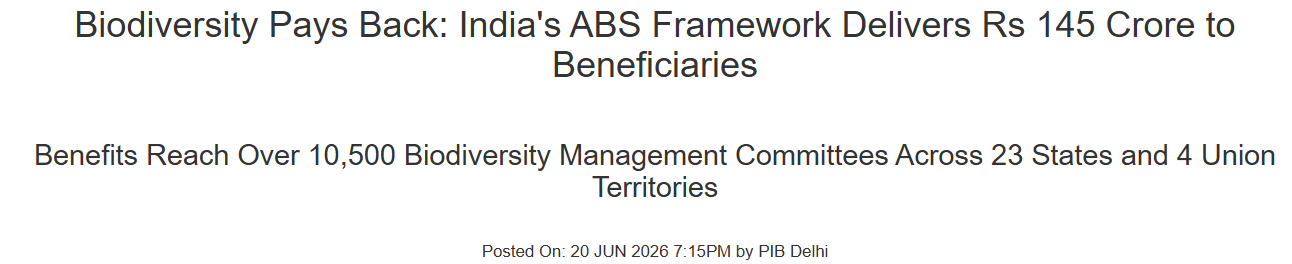
India's Access and Benefit Sharing (ABS) framework under the Biological Diversity Act, 2002 has mobilized more than Rs 266 crore towards benefit sharing and disbursed around Rs 145 crore to beneficiaries, demonstrating the country's leadership in ensuring fair and equitable sharing of benefits arising from the utilization of biological resources and associated knowledge.
About ABS framework:
India's Access and Benefit Sharing (ABS) framework operationalizes a core mandate of the Convention on Biological Diversity (CBD) and the Nagoya Protocol. Enacted via the Biological Diversity Act, 2002, it ensures that the monetary and non-monetary benefits derived from commercializing or researching the country’s genetic resources and associated traditional knowledge flow back to the native conservers (local tribal and rural communities).
The governance follows a strict decentralized three-tier architecture:
- National Biodiversity Authority (NBA): Decentralized apex body headquartered in Chennai that handles foreign access and Intellectual Property Rights (IPR) permissions.
- State Biodiversity Boards (SBBs): Regulate commercial utilization by domestic entities.
- Biodiversity Management Committees (BMCs): Local-level bodies responsible for documenting local resources in People’s Biodiversity Registers (PBRs).
Now,
About NBA:
The National Biodiversity Authority (NBA) was established in 2003 by the Central Government to implement India’s Biological Diversity Act (2002).
The NBA is a Statutory body and that performs facilitative, regulatory and advisory function for Government of India on issue of Conservation, sustainable use of biological resource and fair equitable sharing of benefits of use.
Composition of NBA:



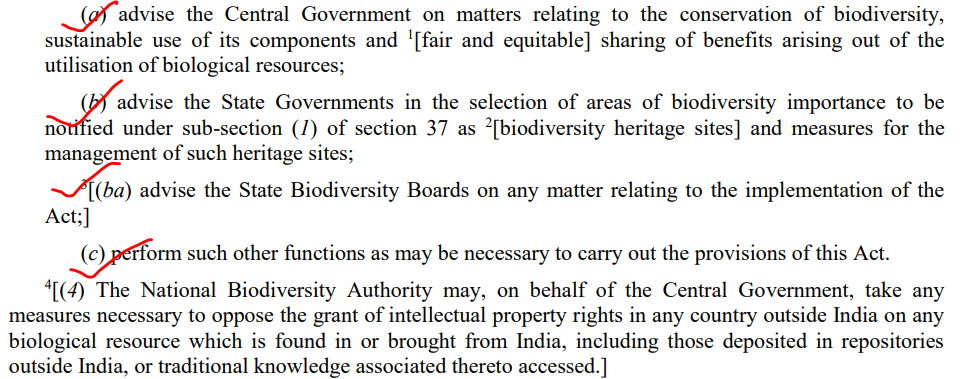
Functions and powers of National Biodiversity Authority:
The National Biodiversity Authority shall, with the approval of the Central Government, make regulations to provide for access to biological resources and traditional knowledge associated thereto, and for determination of fair and equitable sharing of benefits.
Now about Biodiversity Management Committees (BMCs):
Under Section 41(1) of the Biological Diversity Act, 2002, every local body in the State shall constitute a Biodiversity Management Committee within its area of jurisdiction for the purpose of promoting conservation, sustainable use and documentation of biological diversity.
Composition of BMC:
- The BMC consist of a Secretary and not more than six persons nominated by the local body, of whom not less than one third should be women and not less than 18% should belong to the Scheduled Castes/Scheduled Tribes;
- Provided that the members of the committee shall be the proven resident of the local body and their names should be included in the electoral roll of the concerned local body.
- The Chairperson of the BMC shall be elected from amongst 06 nominated members of the committee in a meeting to be chaired by the Chairperson of the local body. The Chairperson of the local body shall have the casting votes in case of a tie.
- The Secretary of the BMC shall be the Gram Sachiv In Gram Panchayat /Panchayat Secretary or any person nominated by the Panchayat Department for Block and District BMCs.
- The local Member of State Legislative Assembly and Member of Parliament would be special invitees to the meetings of the Committee.
In addition to preparation of the People’s Biodiversity Register (PBR), the BMCs in their respective jurisdiction shall also be responsible for the following: -
- Conservation, sustainable use and access and benefit sharing of biological resources.
- Eco-restoration of the local biodiversity.
- Feedback/information to the Board and the National Biodiversity Authority in the matter of Intellectual Property Right (IPR), Traditional Knowledge and local Biodiversity issues.
- Management of Biodiversity Heritage Sites including Heritage Trees, Animals/ Microorganisms etc., and Sacred Groves and Sacred Water bodies.
- Regulation of access to the biological resources and/ or associated Traditional Knowledge, for commercial and research purposes.
<< Previous Next >>