





Concept of Additional judge in Indian Constitution.
Jun 02, 2026
Current Affair 1:
Concept of Additional judge in Indian Constitution.
News:

The appointment and progression of Additional Judges are governed by Article 224 and Article 217 of the Constitution.
- Appointment as an Additional Judge (Article 224):
If there is a temporary increase in the business of a High Court or a massive backlog of pending cases, the President can appoint qualified persons to be Additional Judges.
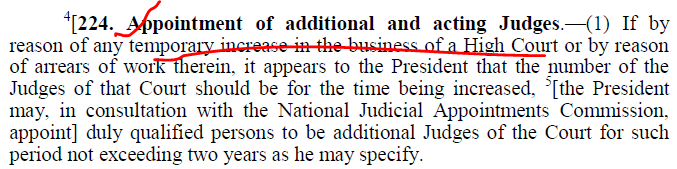
The Tenure: Additional Judges are not permanent. They are appointed for a temporary period not exceeding two years.
Like all High Court judges, an Additional Judge cannot hold office after reaching the age of 62 years.
- The Transition to a Permanent Judge (Article 217):
When a permanent vacancy opens up in the High Court (due to retirement, resignation, elevation, or expansion of the permanent strength by the Parliament), an Additional Judge is considered for appointment as a Permanent Judge.
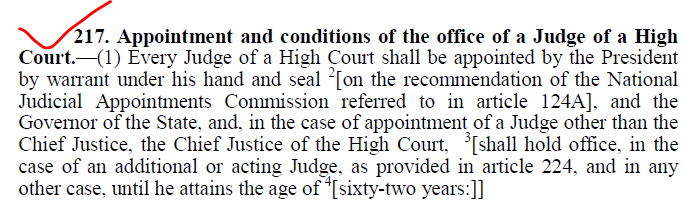
The Process: This transition is not automatic. The Additional Judge's name must be recommended by the Supreme Court Collegium (consisting of the Chief Justice of India and the two senior-most judges of the Supreme Court), along with inputs from the High Court Collegium and the executive branch.
Once approved, the President of India formally appoints them as a Permanent Judge by issuing a fresh warrant under his hand and seal under Article 217(1).
One thing you remember;
The expression "Permanent Judge" is not found in the text of Article 217, but is a commonly used constitutional term to distinguish such judges from Additional Judges.
<< Previous Next >>